
The Biosecurity Manager and the SPS Plans

The Secure Food Supply (SFS) Plans for dairy, beef, sheep, swine, and poultry describe the Biosecurity Manager as the person responsible for developing and updating a site-specific enhanced biosecurity plan. The Biosecurity Manager can be an owner, manager, veterinarian, or employee on-site. If the Biosecurity Manager is not a veterinarian, they should work with their veterinarian and/or other SFS biosecurity experts when writing their site-specific enhanced biosecurity plan.
Toolkit Quick Links
Biosecurity Manager Responsibilities
The Biosecurity Manager is responsible for leading and managing the biosecurity activities of livestock operations. Explore this site or download the guide to learn about the main responsibilities of Biosecurity Managers and get helpful information Biosecurity Managers need to succeed.


1. Know the site layout, management, and biosecurity practices
Site layout and management
The Biosecurity Manager must be familiar with the layout and management of the site, including where animals are housed and the movement of vehicles, equipment, animals, and products on, off, and within the operation.
Creating a premises map resource is valuable for this purpose. Find resources on the CFSPH and Secure Food Supply websites.

Biosecurity practices
Biosecurity, defined in the SFS plans, refers to management practices implemented at different levels to keep diseases off the operation.
Knowing how diseases spread helps you prevent them. Diseases can be spread by direct contact, indirect contact, through the air, food, and vectors like flies and ticks, birds, rodents, and other animals, including pets and wildlife.
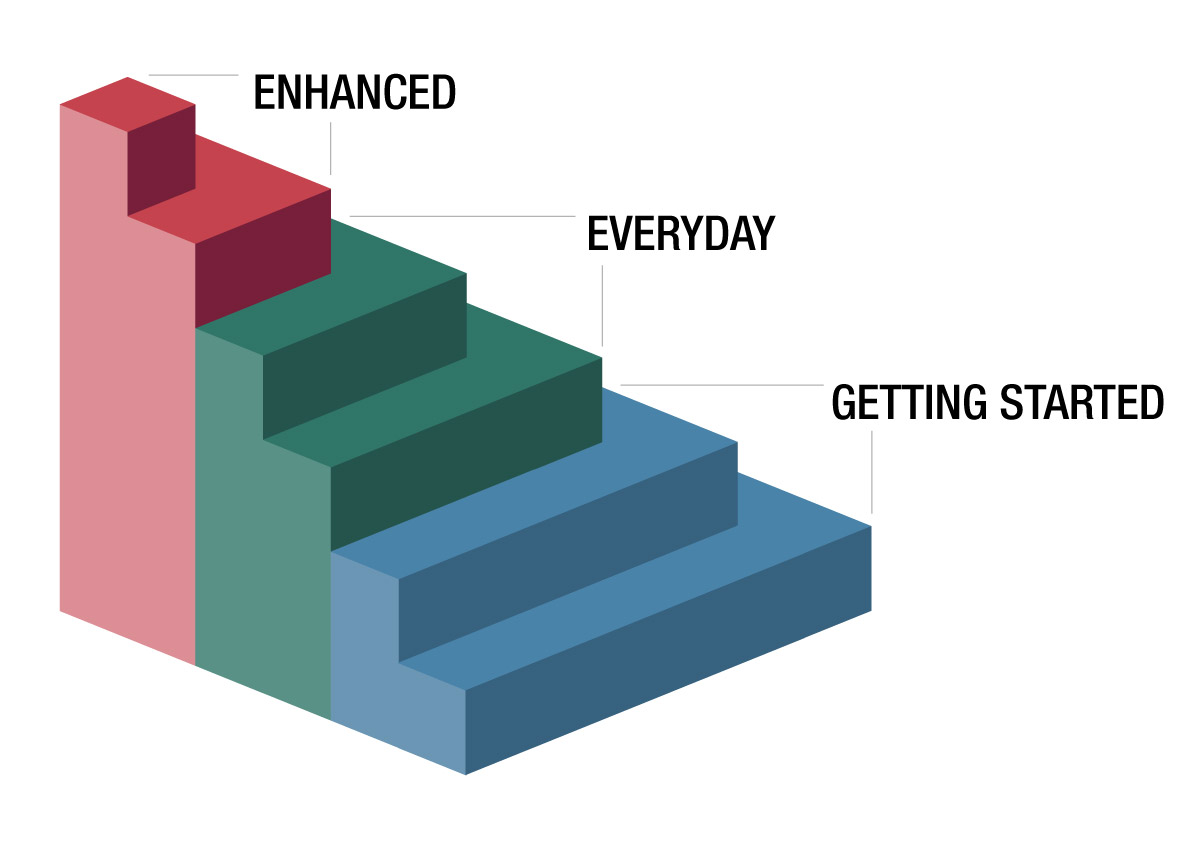
You can think of developing a biosecurity plan as a stair-step approach, where you start with small steps and progress over time. Everyday biosecurity (also known as daily biosecurity) is a set of management practices that protect animals and people from exposure to disease. Everyday biosecurity is meant to be used routinely to prevent common endemic diseases. It is the foundation of biosecurity. Enhanced biosecurity builds on that foundation.
Where are you at with your biosecurity?
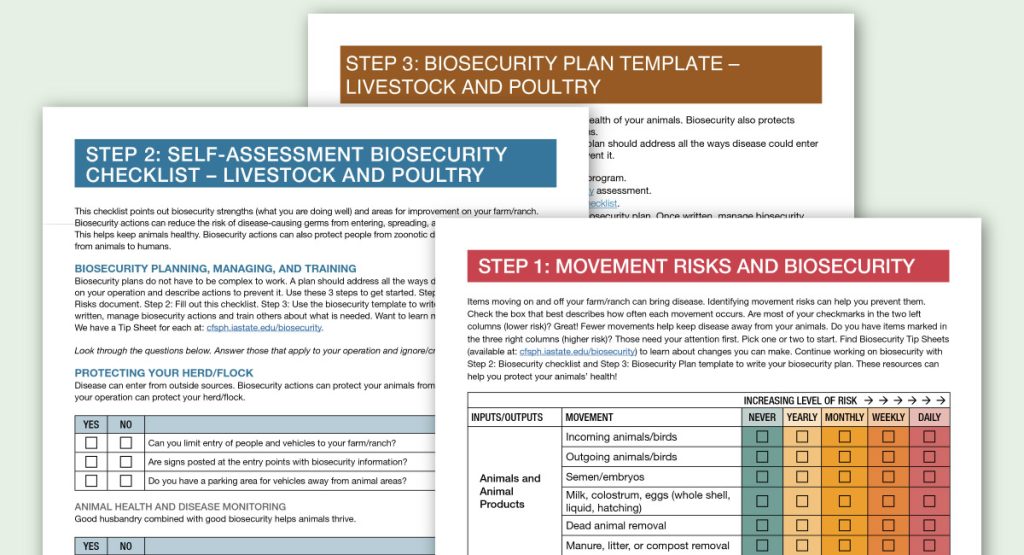
This three-step process is a simple way to start with the key everyday topics of biosecurity described. Conduct a self-assessment to help identify risk areas:
More information on disease risk and prevention activities can be found on the Farm Biosecurity page.
2. Develop, update, or revise an enhanced biosecurity plan
Enhanced biosecurity
Enhanced biosecurity refers to practices that align with the SFS plan specific to the species on that operation, and are meant to be used during an outbreak.
Developing or updating a written enhanced biosecurity plan before an FAD outbreak will help your operation stay in business and keep animals healthy during an outbreak.
Each SFS website has one or more enhanced biosecurity templates (see the Additional Resources section). These are good places to start when developing or updating your written plan

Training and building a team to help write/execute an enhanced biosecurity plan:

Choose a staff member to oversee and coordinate the process.

Make sure staff cooperate with the team.

Ensure good working relationships
If your operation has multiple species on the site, you may need various checklists and/or templates to write your enhanced biosecurity plan. Suppose an operation has multiple sites with animals. In that case, each location will need to have its own written enhanced biosecurity plan defining the scope of the operation, and copies of the plan should be readily available to people who enter the site frequently.
Biosecurity Managers should review the biosecurity plan at least annually and whenever the site goes through a change that affects biosecurity (expands, adds a new aspect of the business, and/or makes changes). Biosecurity Managers should also prepare to have their biosecurity plan reviewed by their site’s veterinarian and state animal health agency. Specific requirements vary by state. Find more information about your species and your state’s requirements on the SFS websites and from your state Department of Agriculture or Board of Animal Health.
Components of the Enhanced Biosecurity Plan
The following topics expand on everyday biosecurity practices and are examples of concepts that must be addressed in the operation’s enhanced biosecurity plan. Visit the SFS website for specific requirements for the species on your operation. Your veterinarian, industry groups, and regulatory officials can be a good source of information besides the SFS Plan websites.

The enhanced biosecurity plan should:
Include a map of the site labeling important aspects of biosecu rity, consisting of the site entry, Line of Separation (LOS), Perimeter Buffer Area (PBA) if applicable, access points through the LOS and/or PBA, Cleaning and Disinfection (C&D) station, designated parking, and carcass disposal/pickup locations, as well as routes for vehicle and carcass movements.
Describe how you protect animals on your operation through lines or layers of biosecurity. Mark the lines or layers on the map and within the operation. A LOS is required for all sites; this is a control boundary meant to prevent movement of an FAD into areas where susceptible animals could be exposed. For some operations (including poultry housed indoors), a PBA is also required; this is an outer control boundary (surrounding the LOS) meant to limit movement of an FAD near animal housing before additional biosecurity practices must be followed to cross the LOS. More resources are available on determining the best location for the LOS and PBA (see the Additional Resources section).
Describe how you will protect animal movements that need to occur on the farm. Determine how people, vehicles, equipment, and supplies may safely cross one or more lines or layers of biosecurity. This includes animals, feed, manure, carcasses, animal transport vehicles, and animal products such as milk, semen, embryos, and wool. These movements should occur at a designated access (entry) point for that type of entry. Depending on what is crossing, wearing personal protective equipment such as clean boots and clothing, cleaning, and disinfecting items or vehicles, and/or one-way traffic flow may also be required. Additional resources include Standard Operating Procedures (SOPs) for key movements: SOPs for Personnel Entry/Exit
SOP for Establishing Line of Separation and Access Point.
Cleaning and disinfection (C&D) is a process that removes and kills disease-causing agents on equipment and surfaces. Additional resources include an SOP for establishing and operating the cleaning and disinfection station.
Describe how to control rodents, vectors (like flies or ticks), birds, wildlife, and other animals, preventing them from having contact with the animals and bringing disease onto the operation.
Describe how you will provide the necessary training on all practices included in the enhanced biosecurity plan to those working on or visiting your operation.
Communicate biosecurity practices to everyone who enters the operation
Worksheets, Checklists and Templates
Additional Resources

Biosecurity Basics
The “Biosecurity Your Way” website has great resources to help learn about the basics of biosecurity and to practice designing and customizing a plan.
FAD field guide
The FAD field guide presents possible signs of FADs to help you recognize and report them quickly.
FAD Readiness for Farms Videos
Healthy Farms, Healthy Agriculture (HFHA) is a great website with excellent biosecurity resources and FAD readiness videos like these: